
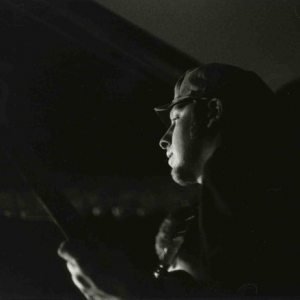
Casey O’Brien — Long-Form Biography
Bassist | Composer | Improviser
Casey O’Brien is a bassist, composer, improviser, and producer whose work spans continents, genres, and communities. Known for his deep-pocket grooves, open-eared collaboration, and unshakable commitment to improvisation as both practice and principle, O’Brien has built a quietly influential career that connects Minneapolis’ underground soul-jazz scene to far-reaching improvisational communities in East Africa, Southeast Asia, and Europe.
Born in St. Paul, Minnesota, O’Brien grew up surrounded by music. His father, a boundary-pushing trumpeter and musical thinker, instilled in him a love for sonic exploration early on. The records in the house told a wide-ranging story: avant-garde pioneers like Cecil Taylor and Bill Dixon played alongside soul legends like Donny Hathaway and pop visionaries like Prince and Björk. That collision of freedom and form still defines O’Brien’s approach—never fully inside or outside the lines, always in search of the next question.
O’Brien began studying upright bass as a teenager under the mentorship of jazz great Anthony Cox, who emphasized both deep listening and an unflinching commitment to creative honesty. At the same time, he took up electric bass with Jim Anton, a seasoned groove player known for his work in soul, funk, and rock. The dual education gave O’Brien a unique fluency across styles, one foot planted in the spiritual openness of jazz, the other in the disciplined propulsion of rhythm and blues.
His first major creative chapter came as the bassist for Face Candy, a raw and radical improvisational jazz-rap group formed by Rhymesayers MC Eyedea. With no rehearsals and no predetermined forms, Face Candy built live sets from scratch—Eyedea and Kristoff Krane on the mic, O’Brien and drummer JT Bates underneath, spinning the floor. Their music was unfiltered, urgent, and defiant. It exposed O’Brien to a generation of listeners hungry for something that resisted genre but demanded presence. This period marked the start of O’Brien’s enduring investment in risk, trust, and the ephemeral power of performance.
From there, O’Brien became a central fixture in the Twin Cities’ music community, working across jazz, soul, hip-hop, and experimental scenes. He was a founding member of Coloring Time, a rotating collective of improvisers that held a ten-year residency in Minneapolis. As part of this project and others, he collaborated regularly with forward-thinking artists like Nathan Hanson, Davu Seru, JT Bates, and Graham O’Brien, developing a shared language built on open structures, emotional precision, and deep-rooted groove.
Parallel to his performance work, O’Brien built a robust profile as a producer and musical director, most notably for PaviElle, the powerhouse vocalist and Emmy/Sage Award-winning interdisciplinary artist. Under his direction, PaviElle’s sound evolved from raw soul into a larger, cinematic vision—complete with horns, string arrangements, and a theatrical sense of drama. Their partnership resulted in national press, PBS features, and accolades from the Twin Cities arts community.
In 2015, O’Brien released Ghost Dance, a critically acclaimed trio album with saxophonist Nathan Hanson and percussionist Davu Seru. The record blended delicate melodic forms with wide-open improvisation, drawing comparisons to ECM’s classic European jazz catalog. Vita.MN called it “a low-key gem,” placing O’Brien in the lineage of spiritual jazz adventurers like Don Cherry and Charles Lloyd.
That same year, O’Brien embarked on a new sonic direction with Eudaemonic, a solo record constructed from field recordings, ambient textures, and manipulated bass tones. Composed during and after travels through Southeast Asia, the project reflected his growing interest in site-specific sound, environmental listening, and meditative time scales. Eudaemonic revealed the introspective, textural side of his artistry—one rooted less in performance and more in composition, sound design, and ritual.
This commitment to global conversation led O’Brien into deeper cross-cultural work. He studied Indian classical music and sitar with Neeraj Mishra in Varanasi and participated in a groundbreaking residency at Nyege Nyege Studios in Kampala, Uganda—an influential hub for African experimental electronic and hybrid music. He also performed across Ethiopia, Vietnam, and China, building musical relationships that transcended language and geography.
In 2021, O’Brien began a two-year residency at the Northgate Jazz Co-op in Chiang Mai, Thailand. There, he curated and led a weekly improvised music night that drew from Thailand’s growing community of jazz musicians and international improvisers. Over time, these sessions evolved into a full band and a collective voice. The result was The Arkive Sessions, a record documenting six months of live recordings—raw, intuitive, and direct from the floor. The album stands as both a snapshot of the scene and a philosophical statement about process over polish, presence over perfection.
Now based in Europe, O’Brien continues to collaborate internationally while also grounding himself in new local creative communities. He is active as a composer and bandleader, and continues to work with longtime collaborators including Ted Godbout, and Pete Hennig. In 2025, he will release 2nd Set: Live in Minneapolis, a love letter to the city that raised him, recorded at Berlin in the North Loop in July of 2024.
At the heart of Casey O’Brien’s work is a belief in music as a life practice—a way of staying curious, resisting stagnation, and connecting with others across difference. Whether he’s composing ambient scores, producing theatrical soul, or improvising in real time with strangers, O’Brien brings the same ethos to the table: music is a conversation, and every moment counts.

